Executive Insights & Advisory
Growth brings new challenges: why leadership and people systems matter more than ever
For growing organisations, success often introduces friction before it produces freedom. Thriving through scale requires two interdependent pillars: deliberate leadership capability and durable people systems.
1. The hidden friction of organisational growth
In an organisation's formative phase, decision-making is swift and centralised. Founders and early leaders remain deeply embedded in day-to-day operations, course-correcting in real time across small, tight-knit teams. As the company scales past key inflection points (typically 20, 50, and 100+ team members), that operating model hits a natural ceiling:
Executive bottlenecking
Senior leaders become trapped acting as quality control for every operational decision.
The "peer-to-leader" dilemma
Individual contributors are promoted into management without formal supervisory toolkits.
Communication drag
Cross-departmental alignment dissolves into silos, duplicated effort, and conflicting priorities.
Diffused accountability
When ownership lines are blurred, missed targets are met with finger-pointing rather than systemic diagnosis.
Employee friction
High performers experience fatigue and reduced engagement as clarity declines.
These friction points are not signs of organisational failure. They are the predictable consequences of growth. The defining difference between organisations that scale sustainably and those that plateau lies in how intentionally leadership responds.
The Managing Director's reality: trapped in the operational engine room
Having built the business through sheer personal momentum and hands-on oversight, the MD often finds themselves caught in an exhausting paradox: revenue and headcount are climbing, yet operational autonomy is shrinking. Without confident frontline managers or codified processes in place, every client escalation, internal disagreement, and quality variance routes straight back to the MD's desk. Instead of dedicating time to strategic expansion, partnerships, and high-value commercial opportunities, the MD remains the default chief firefighter. Stepping back feels risky — not because the MD wants to micromanage, but because the business lacks the managerial bench strength and systemised guardrails required to run dependably in their absence.
2. Leadership capability does not automatically grow with the business
One of the costliest assumptions in expanding businesses is that exceptional technical performance translates automatically into effective people leadership.
Technical expertise and leadership capability are fundamentally distinct disciplines.
When high-performing specialists are promoted to lead teams, they are suddenly accountable for:
- Navigating performance management and setting objective metrics.
- Delegating outcomes rather than micromanaging processes.
- Conducting high-impact 1-on-1s and developmental coaching.
- Addressing difficult performance issues early without conflict avoidance.
- Translating strategic objectives into daily team execution.
Without structured training, newly appointed team leads face stress, isolation, and self-doubt. The business loses its top individual contributor and gains an under-supported manager. Investing in foundational leadership disciplines protects morale, builds operational resilience, and establishes consistent standards across teams.
3. Systems must scale alongside people
Leadership capability is only half of the equation. Even the most capable leaders struggle within fragmented, ad-hoc operational environments. Informal "hallway agreements" and tribal knowledge that functioned smoothly across 10 people create gridlock across 50. Without scalable people systems, organisations suffer from:
- Ambiguous job boundaries and overlapping responsibilities.
- Unpredictable hiring rubrics and poor role benchmarking.
- Inconsistent performance appraisal cycles that fail to drive real development.
- Information gatekeeping and delayed operational handoffs.
| System area | Scaling risk without structure | Scalable solution |
|---|---|---|
| Role clarity | Overlapping responsibilities, dropped tasks | Explicit role scorecards & decision-rights matrices |
| Performance cadence | Annual surprise reviews, stagnant accountability | Continuous 1-on-1 rhythms & objective KPI alignment |
| Talent pipelines | Frantic reactive hiring, cultural misalignment | Structured competency rubrics & succession plans |
| Cross-functional flow | Departmental silos and execution bottlenecks | Clear operating rhythms and escalation frameworks |
When structured thoughtfully, people systems do not introduce bureaucratic red tape; they create operational autonomy, allowing teams to deliver results without continuous executive intervention.
4. The dual engine: synchronizing capability and architecture
Many business leaders focus disproportionately on one side: they invest exclusively in motivational training while ignoring broken workflows, or deploy rigid software systems without coaching their people on how to lead. Sustainable expansion demands synchronicity:
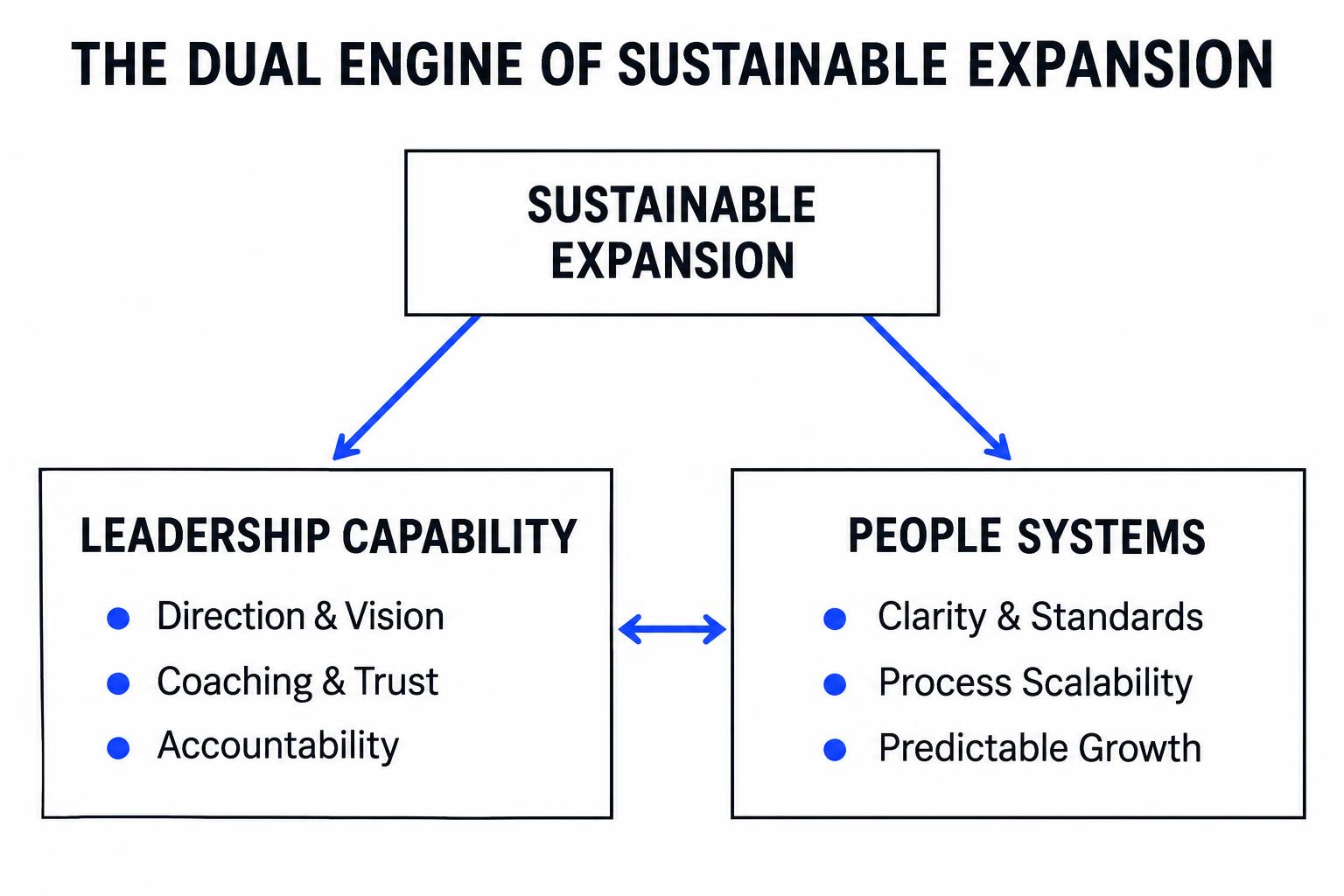
- Leadership provides direction and human accountability.
- Systems provide consistency and institutional repeatability.
Without effective leaders, even well-engineered systems collapse under passive resistance. Without reliable systems, talented leaders burn out firefighting administrative friction. When developed together, they create the organisational stamina needed to capture market opportunities.
5. Strategic diagnostic: is your business prepared to scale?
Executive teams should evaluate their operational readiness against these five diagnostic questions:
1. Founder dependency
Can your primary service or operational delivery run for 30 days without executive intervention?
2. First-time manager support
Do your newly promoted supervisors follow a consistent management framework, or are they improvising?
3. Role & decision clarity
Do team leads know exactly where their decision authority begins and ends?
4. Performance transparency
Are expectations and accountability measures documented, objective, and reviewed on a structured cadence?
5. Workforce alignment
Does your workforce planning and development directly reflect your commercial roadmap for the next 18–24 months?
Building long-term value
Sustainable growth is measured by more than top-line revenue or head-count milestones. True enterprise value lies in building an organisation that performs consistently, develops its own future leaders, and adapts swiftly to commercial shifts.
As your business grows, the question is not whether expansion will test your capacity. The question is whether your leadership capability and people systems are equipped to carry the weight.
Supporting your growth journey
At XZX Business Consulting, we partner with growing organisations across South Africa to institutionalise leadership capability and scale people operations:
Confident Manager Foundations
Practical toolkits and management disciplines for first-time managers and emerging team leads.
The People Systems Playbook
Structured advisory and operational architectures for mid-market firms navigating rapid headcount growth.
equityBI
Data-driven workforce visibility, EAP benchmarking, and compliance planning.
Is your business prepared to scale?
Tell us where your organisation is today and we will recommend the right starting point.